Thursday, December 16, 2010

New Scientific Manifesto


Nature knows no pause in progress and development, and attaches her curse on all inaction.

—Johann Wolfgang von Goethe

A science that is mute about its own ideals is a science that assists in war and imperialism. A science that has no place for humanity is a science that serves the abuse of humanity. A science that is silent about deception, manipulation, and exploitation is a science that is divorced from reality.

If science’s goal is Truth, then science must be an active voice against ignorance. It must be an engaged social agent against all propaganda, ethnocentrism, nationalism, political and industrial deception and economic colonialism, not just a timid backdrop to somehow lesser human ideals.

The ideals of science are to be its cornerstone for they are the ideals of humanity—real natural forces: that which produces science.

The new science is to be a servant of Truth, Life, and Freedom, not the other way around. It is to combat deception and ignorance on all fronts. First and foremost in itself, and then in the social, political, economic, educational, legislative, cultural, and journalistic arenas.

The new science is to be a voice of Truth, Unity, and Justice, lest it remain an emasculated science, a lame philosophy, a knowledge that is mute, deaf, and blind with no concept of Life or reality, and therefore irrelevant.

New site: discoveryofman.wordpress.com

Tuesday, November 2, 2010

Why did the War on Drugs fail?


What you do not know, you will fear. What one fears, one destroys.

—Chief Dan George


When we want to solve a problem, we deal with the cause, not the effect.

The cause of drug trafficking and violence is the demand for drugs, not their production.

The global drug problem was not, cannot, and will not be solved on the side of the supply. It will be solved on the side of the demand.

We do not wage war on addictive behavior: we monitor, research, educate, and overcome.

Saturday, October 30, 2010

The Primacy of Life


When I was a child, I spoke and thought and reasoned as a child. But when I grew up, I put away childish things. Now we see things imperfectly as in a cloudy mirror, but then we will see everything with perfect clarity.

—1 Corinthians 13:11-12

When our science honors Life, our culture will honor Life.

But when our science ignores itself and takes Life for granted, it breeds a culture that takes Life for granted.

Today's science is lost in self-denial: it cannot conceive of itself. It is innocent, superficial, naïve, without substance.

With no concept of Life, and no concept of Man, it cannot see that Life is the world-creating force. That Mind is the technology of Creation. That evolution is the construction of the embodied world. And that it is ready for inauguration.

Wednesday, October 27, 2010

Existential Shame II


And the man and his wife were both naked and were not ashamed.

—Genesis 2:25


Before the Fall, Adam and Eve were not ashamed because they did not yet have the question, but when "their eyes were opened" (Genesis 3:7), they immediately covered themselves.

Shame is covering up what we cannot account for, avoiding a question for which we do not have an answer.

Shame is running from our problems, disowning our weaknesses, denying our faults. Indeed, trying to hide from our Source.

In the future, we will again have no shame. But not because we do not have the question—because we will have the answer.


Image by Fernando Botero.

Tuesday, October 26, 2010

The Theory of Everything


Then will I return to the people a pure language.

—Zephaniah 3:9

The theory of everything will be self-explanatory. It will be self-evident—by definition, it will account for itself. It will be self-aware.

It will not be a materialist theory because materialism is not self-aware. It will be a living, breathing theory that bows to nothing but Life.

It will not just unify the sciences. It will sew together all areas of knowledge with all spheres of life: history, morality, economics, law, language, technology, education, art, personal growth, parenting, health, and all the other good stuff.

A true understanding of existence, it will talk about compassion. It will talk about responsibility. It will talk about gratitude and discipline, and it will talk about freedom.

An effective theory of nature, from the inside out.

The complete understanding, the Promised Land, the final revelation of the Truth about the world and Man. The coming kingdom, the garden of delights, from which we were expelled as sinners, but will return as Kings.

Sunday, October 17, 2010

Questions and Answers


They have all turned aside, they have together become corrupt;
There is none who does good, no, not one.

—Psalm 14:3

Why does our global society ignore that its ultimate goal is truth?

Why does our notion of reality leave out the fact that something breathes?

Why do our schools not teach our children that they are each a world-conception?

Why does our science obviate that there's an organic visual image inside every human being?

Why do our politics, media, textbooks and authorities ignore that all aggression comes from fear?

Why does our culture have no concept of the importance of silence, meditating, and digesting daily stimuli?

Why do our interpersonal, international, interracial and interfaith relations tend to forget that our common hope and destiny is unity?

Why are most people oblivious to the fact that all social, economic, and political problems are only the symptoms of our psychology?

Because our science is blind, our knowledge is ignorant, our belief system flawed.

Saturday, October 16, 2010

Religious Science or Scientific Religion?

A physical scientist does not introduce awareness (sensation or perception) into his theories, and having thus removed the mind from nature, he cannot expect to find it there.

—Erwin Schrödinger, Mind and Matter

Whenever a belief system ignores the question, the problem, the miracle of human perception, it ignores life, denies existence, and abdicates self-awareness—the very thing which makes us human.

For any science and philosophy, the question is not whether reality is in-dependent or not of our perception. The question is why we should be perceiving at all in the first place.

And wondering about it too.

This is the human question, the meaning of self-awareness—this is what science must now answer.

And then it will become what it has always sought to be.

Monday, September 27, 2010

The World is a Metaphor


In the beginning was the Word.
—John 1:1

The world is a metaphor.
All word is a metaphor.
All myth, all concept,
All science is too.

The trick is to not take it literally.
To see that metaphor is real.
The very fabric of the universe.
That of which Truth is made.

And we
Are the tools
Of the Maker.


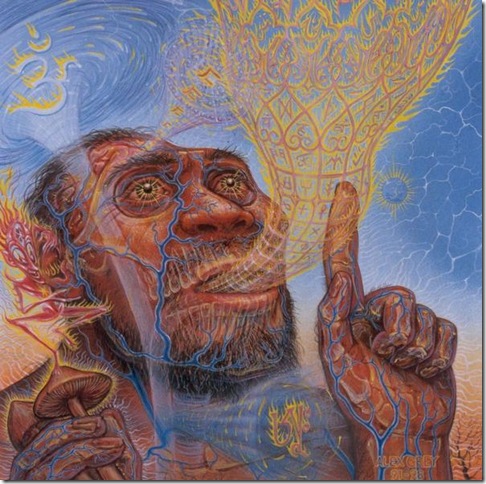
Image by Alex Grey.

Saturday, September 25, 2010

Existential Shame


He answered, "I heard you in the garden, and I was afraid because I was naked; so I hid."
—Genesis 3:10


The only place where modern man feels comfortable exposing himself is in a closed-off space, a bathroom, inside another closed-off space, a house.

We have dug so far into this existential trauma, this cognitive concealment, that it is now unheard of—illegal!—for a human being to bathe in plain sight.

What strange being goes through so much trouble when rain falls freely out in the open?

Such is the edifice of concepts, arguments, and convictions which the materialist mind has built around itself to cover up its self-awareness.

To keep from coming into contact with that uncomfortable question, that forbidden fact, that impossible "problem of perception"; the "problem of consciousness"; the ubiquitous specter of its own existence.

Saturday, September 18, 2010

Self-Aware Science: Evolution is Intentional

I have hitherto sometimes spoken as if the variations [...] had been due to chance. This, of course, is a wholly incorrect expression, but it serves to acknowledge plainly our ignorance of the cause of each particular variation.

—Charles Darwin, On the Origin of Species

Materialism is the philosophy of the subject who forgets to take account of himself.

—Arthur Schopenhauer, The World as Will and Representation

The standard view of evolution says that evolution is random, that life is accidental, and that nature has no purpose. But what about its purpose, its goal, its intent?

Science is surely searching for something, and is it not also of nature?

Materialism was unable to form a coherent picture of the world because it ignores that there is something forming pictures of the world: it lacks a useful understanding of Man because it ignores Man’s striving for understanding.

Materialism failed because it is blind unto itself. It falls for the illusion and chases idols on top of idols in eternal return. So we get a knowledge with no meaning, a culture with no purpose, and a world with no light.

It is by no quantum probability, special relativity, weak force, strong force, genetic drift or chemical reaction that you are reading this piece: it is because you want to that you are reading this.

The Will exists.

It is real, palpable, it is a part of nature. But it is not visible or touchable. It is beneath and beyond the physical spectrum of perception—a non-visible force, a meta-physical natural phenomenon.

And it is observable.

It is the snail slithering up the tree, the tree digging down through the Earth. It is the orchid opening up, the infant learning how to walk. It is our getting up in the morning, and it is you reading this sentence.

But because it is not visible, touchable, or measurable, the Will does not exist for the materialist worldview. And you will not see this in a scientific journal because it is the blind-spot of contemporary science, its yearned-for substratum, its buried keystone.

What kind of world-picture leaves out the world-creating force? An innocent one, a naïve mentality, one that is not yet self-aware.

But we are self-aware, and evolution continues.

And as we see beneath the surface and embrace the Will to live into our understanding of the organism, then we see that Life and evolution are not all that accidental, coincidental, random, etc. No—we are nature. The universe is intelligent. Reality is organic. And evolution is intentional.

The end, the goal, the finality of evolution is nothing physical though, which is why materialism sees it not.

The purpose is pre-physical: biological evolution is the adaptation of mind; the calibration of consciousness; the unfolding of reality; the unraveling of existence.

The self-creation of the world. An embodied world.

And it is more trial and error than it is random mutation. For how random is science? Did Einstein randomly come up with his great theory, Darwin accidentally write On the Origin of Species, and Copernicus un-intentionally put the Sun as the center of his system?

No, science is the search for truth; the exploration of experience; the purposeful proliferation and natural selection of psychological adaptations. And a perfect microcosm for evolution: the natural progression towards ever more conclusive living drafts of this embodied world.

The free market of mentalities; the cross pollination of ideas; the natural selection of belief systems—the increasing perfection of the walking universe.

So when people have a problem with the materialist conception of evolution, it is with good reason: when researchers and educators claim that life is accidental and purposeless, they are professing plain ignorance—in the words of Darwin. Ignorance served as science.

But creation continues, and science evolves.

Are we ready to embrace intention, purpose, responsibility? Does science dare uncover itself?

Friday, August 27, 2010

The Golden Calf, Redux


For while they live among his works, they keep searching, and they trust in what they see, because the things that are seen are beautiful.
—Wisdom 13:7


Modern science has historically built on the belief in an objective reality in-dependent of human existence and all life.

But in cementing this seemingly innocuous assumption, the entire modern myth ignores the fact that our view of the universe is always limited and contingent; that all we ever see, think, touch and smell is never in-dependent, but entirely dependent upon our cognitive activity, this human existence, and always an image of our own creation.

For we are terrified of the mind's plasticity, we'd rather reality not be so malleable. So we rely on the outside before the inside, hold up our perceptions above our perceiving, and wind up with a global myth that in its claims of "objectivity" is nothing more than a delusion, a deception, a magnificent mirage.

And so the culture runs mired in ignorance because its myth has started out by ignoring itself. As humanity continues fumbling through the darkness chasing its own shadow, worshiping effects before their causes, and placing its creations before their Creator.

A backwards world-view making for a backwards world. A tower teetering on flimsy foundations.

How long will it stand?

Saturday, August 7, 2010

Truth and Illusion

There is but one truth, and that is the truth in which all is One.

—Aurelio Díaz Tekpankalli

Is it true that we exist without the earth from which we're made, the water pulsing through our veins, the air feeding our brain, the Sun rising every day?

Is it true that the Sun exists without its planets?

Is it true that the Earth exists without humanity?

Is reality then in-dependent of us?

No.

And that is the lie on which the dominant world-myth is based.


Image by Alex Sastoque.

Sunday, July 25, 2010

Gaia's Schizophrenia III


III. "When you make the two one"

When you strip without being ashamed, and you take your clothes and put them under your feet like little children and trample them, then you will see the son of the living One, and you will not be afraid.
—Gospel of Thomas 37

Some proudly proclaim that religion is the root of all evil, but when God's name is "I AM THAT I AM", denying God's existence is denying our own.

And that is exactly what materialism has done. Modern science has failed to form a coherent picture of the world because it has banished to oblivion an entire field of observation, a very real part of the universe: itself.

Science and religion are not incompatible, they are incommensurable: they are two different stories told in two different languages, and their terms are not interchangeable. Yet they are very much concerned with the same thing—reality—but they spring from the antipodes of that old question: what is reality?

Science has historically said matter, while religion answers mind. But how could we possibly measure this force?

The idea of a life-force has been around since Aristotle and has not left the biological imagination since. Yet this concept of an entelechy—the ultimate cause and effect; holding one's purpose within —has not been realized into any concrete theory either. We looked for that underlying element in the development of lifeforms but found nothing mysterious, just chemicals. We tore nature to pieces and were left empty-handed.

Of course we will not find the vital component when we negate its existence.

The entelechy is not hidden, it is dreadfully explicit. It is what we call "us": "you" and "I"—intention itself—and it is nothing physical.

People say that life is just matter and then go to great lengths to defend their perceptions. But the materialist mentality cannot perceive the meta-physical element of perception because it is nowhere to be seen, it is seeing itself.

The notion that life is no more noteworthy than dirt can also be understood in religious terms. The story of the Old Testament is a story of bondage and liberation, of exile and return. The subjugation of the believers can be read as literal narrative, or interpreted as spiritual allegory.

Orthodox Jews call this moment in history 'galut', which means exile. The disconnected state of our society and indecipherable world chaos coming from a single source, a spiritual malady, a psychological bondage removing Man from his essence. The belief that he does not believe; the awareness that there is no awareness; the intention that denies intending.

Are we willing to reconsider the main tenet of religions, look inside, and ask: does perception want to perceive?

For the good news is that in this story, the exiles return, the captives are liberated, the error corrected. And "the world shall be filled with the awareness of God as the waters cover the ocean floor" (Isaiah 11:9).

So what if we join the premise with the method? What if we declare intention, emotion, and perception to be "real" parts of the universe? What if we allow ourselves back into our picture of the world?

When the scientific eye stops overlooking the fact that it can look; when it ceases priding itself of having deposed anything; when we are willing to let go of our most sacred assumption, then we may truly call ourselves scientific.

When we take a look back at the questions that generated our vast understanding; when we acknowledge the fact that "the familiar universe of matter and energy" comes together only through our faculty of mind; when we are ready to embrace Eve's dis-covery and stop hiding from ourselves, then the vitalist stance might offer fertile ground for a theory of life, a theory of intention, a theory of everything.

And when science finally finds the answer to existence, may we all be so amazed as to collapse in tears and reverence.


Bibliography

Feyerabend, Paul K. Against Method: Outline of an Anarchistic Theory of Knowledge. London, UK: Verso, 1975.

Freeman, Tzvi. Bringing Heaven Down to Earth: Meditations and Everyday Wisdom from the Teachings of the Rebbe, Menachem Schneerson. Holbrook, MA: Adams Media Corporation, 1996.

"Gödel's incompleteness theorems." Wikipedia: The Free Encyclopedia. Wikimedia Foundation, Inc, 2004. 08 Dec. 2008.

"Religion." The American Heritage® Dictionary of the English Language, Fourth Edition. Houghton Mifflin Company, 2004. Dictionary.com. 07 Dec 2008.

"Science." The American Heritage® Dictionary of the English Language, Fourth Edition. Houghton Mifflin Company, 2004. Dictionary.com. 07 Dec 2008.

Scott, Eugenie C. Evolution vs. Creationism: An Introduction. Westport, CT: Greenwood Publishing Group, 2004.

Images by William Blake.

The Great Red Dragon and The Woman Clothed In The Sun, c. 1805.

Behemoth and Leviathan, 1825.

Jacob's Ladder, c. 1800.

Gaia's Schizophrenia: A Mytho-logical Crisis


I. Knowledge and Reunion.

Then the eyes of both of them were opened, and they realized they were naked; so they sewed fig leaves together and made coverings for themselves.

—Genesis 3:7

Science and religion have been at odds for centuries, but why are they still in conflict? Why hasn't one won already? Could it be that they each hold what the other desperately needs?

Science has allowed man to peer into the deepest workings of the universe and to do things we never imagined. The usual school lesson is that we now know how things work, and that the quaint myths of primitive cultures lay bare the fact that they did not know any better. We hold our rational mindset to be absolute and inerrant, our technological society being evidence of intellectual supremacy.

Why then do these old myths still captivate the minds of most people?

The problem lies in the opposing philosophies that underlie the two bodies of knowledge. Modern science has historically built on the ontological theory of realism or materialism—the belief that reality is entirely physical and it exists independently of life—while religions are all based on what has been termed mentalism, idealism, panpsychism, etc—the belief that reality is primarily non-physical, the basic substance of the universe then being the soul, spirit, or mind.

While materialism is not a necessary component of scientific knowledge or methodology, is incompatible with religious or spiritual knowledge. Thus if there is any quarrel between the religious and the scientific, it is this ancient philosophical debate about the nature of reality.

The question is a muddy one: what is reality, mind or matter? Are we a purposive force or just dust and water? The dichotomy hints to no easy answer as the two extremes seem to be inescapable facts of our experience, hence the two birthing hypotheses of our protagonists.

Religion is "a set of beliefs concerning the cause, nature, and purpose of the universe, especially when considered as the creation of a superhuman agency or agencies, usually involving devotional and ritual observances, and often containing a moral code governing the conduct of human affairs" ("Religion").

Religion declares an overarching law responsible for human life and everything in existence; the meta-physical source of our being from which we can derive guidance and counsel through the intricacies of our personal experience.

Monotheism is the consummation of the mystical mentality responsible for all the myths of our ancestors: from spirits to gods to God, the spiritual belief in more than matter evolved into the story of Oneness that has not left the human mind since. It has been a source of meaning, answers, and strength for humanity for several thousand years.

But Man was more curious than that. If we were all brothers and sisters and everything was for ultimate good, why was there still war, famine, slavery, disease? We still had problems and questions, and the struggle for survival meant a fight for knowledge. Human reason still had plenty of patterns to decode and the ongoing observation of the cosmos and our selves culminated with the distillation of our very decoding process.

The scientific method offers a systematic procedure for finding a question, postulating an answer, and testing for validity, producing what we now know as science: "a branch of knowledge or study dealing with a body of facts or truths systematically arranged and showing the operation of general laws" ("Science"). Science generates explanations about our observations; it is an ever-growing collection of patterns and relationships that allows us to apprehend and navigate our world.

The discoveries of the scientific method revolutionized our understanding of the universe as well as our daily lives; it was clear that in matter was where the answers lay. Ignorance and superstition forever exposed by this new approach—the method—philosophical materialism would soon deliver its final verdict, the new overarching law, the Theory of Everything.

Not exactly. The search for a physical theory to answer all questions ran into a stone wall in 1931 with the publication of Kurt Gödel's incompleteness theorems, which show that any mathematical system is self-referencing and thus inconsistent or incomplete ("Gödel").

The hopes for a unified theory in our hardest of hard sciences vaporized with our increasing observation of the universe, and reality now consisted more and more of genocide, slavery, torture, war, addiction, corruption, disease, moral degradation, economic ruin, and an existential void unlike anything man had ever seen.

What happened?

Monday, June 7, 2010

Epistemic Fallacies of Materialist Science


The present state of the world is called "gola" (exile). The state of the world as it will soon be is called "geula" (redemption). The two words are exactly the same, except that "geula" has the letter "alef" inserted in the middle. "Alef" means "master". It also means "one".

To make gola into geula, we only need reveal the alef—the One Master of the Universe who is hidden within the artifacts of our present world.

—Menachem Mendel Schneerson

What are the stars without us?
Something—we know not what.

What is the Earth without us?
We can never say.

What is reality in our absence?
We will never know.

For all our modern knowledge about the universe, every one of those theories, images, and concepts is born out of our embodied cognition: beyond our perception, we can never know what "is".

So before we say that anything exists—to be logically and epistemically sound—we must always say "I am" (saying so and so exist). Anything else is ignorance, self-denial, naïveté.

And that is the fatal flaw of the modern materialist myth.

We cannot escape our existence—why did we ever try to?

Tuesday, June 1, 2010

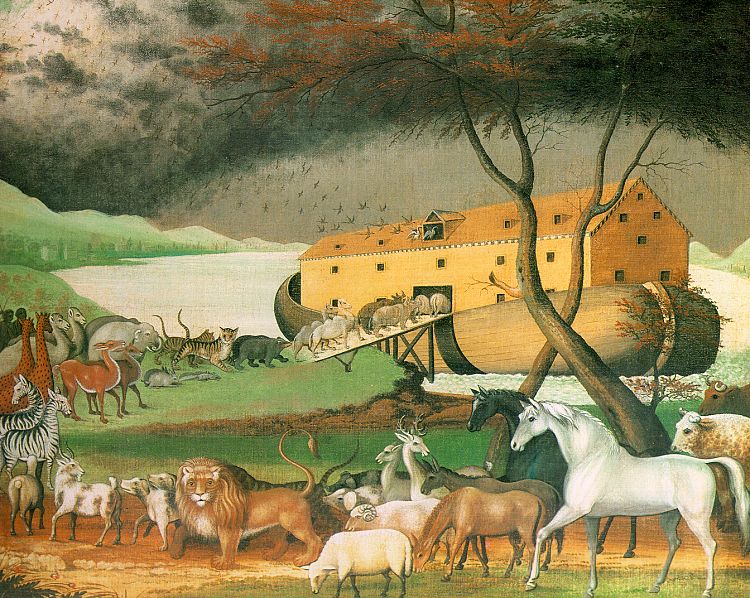
Noah's ark wasn't found—we're just building it


On that day all the springs of the great deep burst forth, and the floodgates of the heavens were opened.

—Genesis 7:11-12

Beneath the chaos and confusion, we're amidst the spawn of a new type of research, a new frontier. A new world of expedition and conquest, the new no man's land: the mechanics of the spirit, the workings of the mind.

A new scientific arena just now in its forming stages, with concepts and hypotheses running to and fro, fast approaching the consolidation of the first consensus framework for a new science of Life, a new model of reality, a brand new re-presentation of the world.

It is not happening in the universities or mass media. It is the worldwide spiritual renaissance with its many names and many faces. It is the coming together of all religious, indigenous and spiritual knowledge into one scientific platform for all humanity to jump on board.

A first-person account of nature; a new world-model to revolutionize the entire world. For the theory of everything was not to be the end of science, only the beginning.

Tuesday, May 25, 2010

Dis-covery III


III. "To Bring Forth the Capstone"

The stone the builders rejected has become the capstone.
—Psalm 118:22


But are we bound to a myth made of isolated stories with no unifying platform? No, science will deliver its unified theory—when it is willing to reassess its most fundamental assumption.

For the fundamental law won't be unearthed in bio-tech labs or billion-dollar particle colliders: the dis-covery of the one entity and unifying principle happened many centuries ago, before we had 'science'—if we could but stop covering it back up.

The new paradigm will be a fully conscious one, for a humanity that is truly self-aware. So let it be heard: the first premise of main stream science is false. The 'realist' hypothesis has been falsified. And what is that dreadful alternative?

To build an understanding that includes all the facts, no matter how uncomfortable. To understand reality as it actually exists—with us. With this embodied experience, with the fickle reality of conscious intending. With the possibility that life might really have a purpose, even if we don't know what it is.

And what if we start again, from the beginning? What if we build a science of perceivers instead of inert particles? What if we step into the fact that we are a force of nature—the creative force?

We are no longer innocent—we are guilty of being. and we can never go back: whether through fig leaves or intricate rationalizations, we will never get rid of our self-awareness. So let us extirpate this parasite and heal the modern myth from its insanity, that great deceiver: the cognitive pathology of covering our being.

And as the fallacy is overturned, the findings of modern science will be found to contain all the pillars on which the world community can recognize divinity.

All that is missing is the keystone, that which the builders refused:


I AM THAT I AM.


So let's end this exile.

Let's uncover ourselves.

Can we bare this existence?

Can we bear our self-awareness?

Let's uproot these vines of self-denial.

Let us lift the veil and exorcise this demon.

To redeem our selves from that original delusion.

And subvert the starting blunder of our universal language.

May we discover the keystone, and let the light unite our Holy Temple.

Alas, it is the path of every individual, and the undercurrent of human history—the hair-narrow bridge between self-awareness and the consciousness of One.


Bibliography

Gustave Doré. Adam and Eve Driven Out of Eden, 1865.

Cornelis Anthonisz. Fall of the Tower of Babel, 1547.

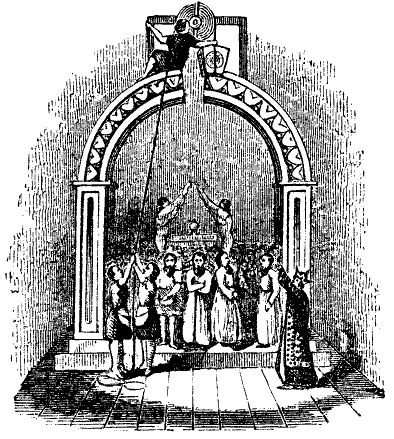
Robert Macoy. The Masonic Manual (p144), 1867.


Dis-covery II


II. The Exile's New Clothes


It is not so much that we need to be taken out of exile. It is that the exile must be taken out of us.
—Menachem Mendel Schneerson

Now I saw clearly the disconnect between my search and modern science: the existence of consciousness is not addressed within the modern myth because it has not been part of its definition of 'reality.'

Can you say existential exile?

Philosophical 'realism' is nothing new, it is the cognitive expression of man's fundamental delusion, the root of all deception: the fear of dying, the feeling that 'I' is separate from 'world', and that therefore our being has no place in our understanding of 'the world'.

As our consciousness develops, we become aware of death, a fact too hard to bear, too hard to face without a context with which to understand it—so we cover ourselves. We hide our existence because we cannot account for it, our body is obscene because we are responsible for it, and we don't know why.

It is the undigested evolutionary trauma of self-awareness; the veil of confusion shrouding human history; and still the foundation of the global myth—all of main stream science's concepts, theories, and entities stem from that plot.

philosophical realism: [ree-uh-liz-uhm]

-psychopathology

1. complete faith in our perceptions while ignoring our perceiving.
2. the belief that reality is what we observe while not that we observe.
3. the rationalization of a psychological inability to consider that being—perceiving—just might be an intrinsic element of the universe.

Thus we get definitions of life such as "complex assemblies of physical particles," personal experience explained away as an "epiphenomenon of physical processes," a universal myth that defines life as survival, and a humanity that refuses to realize its existence.

For the only 'unifying principle; the sciences share right now is that untouchable doctrine: the abnegation of awareness.

Hence a modern myth that is an incoherent picture of the world; a disjointed collection of patterns and relationships; an increasingly specialized set of isolated fields growing like tumors on their one shared assumption—that we don't exist.

That our passions, our fears, thoughts, feelings and clamors; our loving and hating, our decisions and actions; our cultures, memories, dreams and desires; all consciousness, knowledge itself, that because it is subjective, it is not a part of the 'real world'.

Isn't it time we revisit our most ingrained assumptions?

For the problem of unification is not one of technological limitations, experimental evidence, or cosmic meaninglessness—it is a human question. Modern knowledge has not unified because it has banished its own existence; it has refused to see itself as an natural event in the universe it seeks to explain.

How much longer will we hope that we are but side-effects of some yet-to-be-found 'physical' law?

For as she conceals her own perceiving force, the mind binds herself to worshiping fragments of reality, perpetually idolizing its creations in stead of its creating, and sustaining the psychological bondage that keeps the consciousness from Truth, and humanity from Liberty.

How does a community strive for moral integrity and social responsibility when its official knowledge negates the 'reality' of human experience?

How do we promote environmental values, the humane treatment of animals, and universal human rights when our truth author-ities assure us we are not 'real'?

Philosophical 'realism' is the biggest lie in history.

It is the philosophy that denies Sophia; the belief that there is no believing.

Thus the scientific spirit keeps searching for the truth while denying its own searching; humanity advancing the construction, blind to its constructing. Hence this behemoth of contemporary science is a world-conception that ignores conceiving; a construction-of-world without its keystone; a collection of extrapolations with no common thread.

A tower to the heavens without 'I AM'.

A theory-of-world aiding and abetting the global matrix of unconsciousness responsible for the social, political, and existential nightmare of the day.


Pt III

Dis-covery: The Science of Babel


I. The Fallacy of Modern Science


A grapevine has been planted outside of the father, but being unsound, it will be pulled up by its roots and destroyed.
—Gospel of Thomas 40

I went to college to study the nature of life but found that the topic was not very popular, so I studied philosophy and the sciences and hoped for the best. But how did cognitive science not yet have a model for the human mind? How was there no history of consciousness? Why was biology not concerned with the perceptual depth of lifeforms? And how had so much knowledge still not formed a unified picture of the world?

So I looked into the nuts and bolts of the construction of our knowledge. I dug into the philosophy of science. I studied the development of the method and the nature of scientific revolutions. I learned of the ontological foundations and epistemological underpinnings of our civilization's greatest achievement.

Meanwhile I developed my sense of spirituality. I discovered the beauty and power of language. I learned the meaning of myth and came to know the nature of perception. I left my culture behind and saw the likeness in all people. I became aware of the human predicament.

But if I'd finally made sense of my existence, how was modern knowledge still so lost in itself? Why did it still have nothing to say about what it means to be alive, and why was it farther than ever from its most basic goal of unification?

Reading Lee Smolin's The Trouble With Physics, I found the answer I was looking for, and it was the very question. I caught the founding premise of this monumental construct stripped of fancy language: "[To] give an account of reality as it would be in our absence" (Smolin, 6).

What? Why?

Wasn't the idea was to understand reality as it actually exists—with us?

It turns out that the entire worldview set forth by contemporary science grows out of the belief that we are not 'real,' so we must ignore our existence in order to get to the real truth.

Nothing scientific, this is an inductive assumption; the a priori ontological position which has historically informed the development of all the concepts and entities of our universal language. Hence the 'scientific' effort to build a world-picture with no mention of our subjectivity, and the ensuing and unconscious expulsion of personal experience from the dominant culture's conception of nature.

It might be hard to swallow, but that is, quite simply, the foundation of the global myth. It is a view called "philosophical realism", and it claims that our perceived reality exists independently of our perceiving.

But if the value of science is making sound judgments after our observations, why the urge to leave ourselves out of the picture?

Smolin's quick defense of 'realism' shows him at his least eloquent in an otherwise fascinating piece of work: "We are accidental descendants of an ancient primate, who appeared only very recently in the history of the world. It cannot be that reality depends on our existence" (Smolin, 7).

For in reality, yes: our perceived reality does depend on our perceiving: anything we can, ever have, and ever will say about "the world" is contingent upon our cognitive ability, and to cast this fact aside can only be considered naïve.

Such abomination to attempt an understanding while denying understanding!

How do we build a world on the premise that we are not a part of it? And what does it mean when a civilization leaves itself out of its creation story?

Now it all made sense: the scientific enterprise had not answered my question because it had dismissed it from the outset. My intuition had led me in the right direction—humanity's afflictions have no external basis: the root of all evil is psychological in nature. And we are uprooting it now.


Pt II