Tuesday, May 25, 2010

Dis-covery III


III. "To Bring Forth the Capstone"

The stone the builders rejected has become the capstone.
—Psalm 118:22


But are we bound to a myth made of isolated stories with no unifying platform? No, science will deliver its unified theory—when it is willing to reassess its most fundamental assumption.

For the fundamental law won't be unearthed in bio-tech labs or billion-dollar particle colliders: the dis-covery of the one entity and unifying principle happened many centuries ago, before we had 'science'—if we could but stop covering it back up.

The new paradigm will be a fully conscious one, for a humanity that is truly self-aware. So let it be heard: the first premise of main stream science is false. The 'realist' hypothesis has been falsified. And what is that dreadful alternative?

To build an understanding that includes all the facts, no matter how uncomfortable. To understand reality as it actually exists—with us. With this embodied experience, with the fickle reality of conscious intending. With the possibility that life might really have a purpose, even if we don't know what it is.

And what if we start again, from the beginning? What if we build a science of perceivers instead of inert particles? What if we step into the fact that we are a force of nature—the creative force?

We are no longer innocent—we are guilty of being. and we can never go back: whether through fig leaves or intricate rationalizations, we will never get rid of our self-awareness. So let us extirpate this parasite and heal the modern myth from its insanity, that great deceiver: the cognitive pathology of covering our being.

And as the fallacy is overturned, the findings of modern science will be found to contain all the pillars on which the world community can recognize divinity.

All that is missing is the keystone, that which the builders refused:


I AM THAT I AM.


So let's end this exile.

Let's uncover ourselves.

Can we bare this existence?

Can we bear our self-awareness?

Let's uproot these vines of self-denial.

Let us lift the veil and exorcise this demon.

To redeem our selves from that original delusion.

And subvert the starting blunder of our universal language.

May we discover the keystone, and let the light unite our Holy Temple.

Alas, it is the path of every individual, and the undercurrent of human history—the hair-narrow bridge between self-awareness and the consciousness of One.


Bibliography

Gustave Doré. Adam and Eve Driven Out of Eden, 1865.

Cornelis Anthonisz. Fall of the Tower of Babel, 1547.

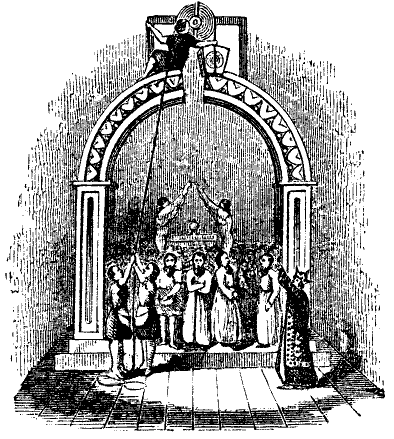
Robert Macoy. The Masonic Manual (p144), 1867.


Dis-covery II


II. The Exile's New Clothes


It is not so much that we need to be taken out of exile. It is that the exile must be taken out of us.
—Menachem Mendel Schneerson

Now I saw clearly the disconnect between my search and modern science: the existence of consciousness is not addressed within the modern myth because it has not been part of its definition of 'reality.'

Can you say existential exile?

Philosophical 'realism' is nothing new, it is the cognitive expression of man's fundamental delusion, the root of all deception: the fear of dying, the feeling that 'I' is separate from 'world', and that therefore our being has no place in our understanding of 'the world'.

As our consciousness develops, we become aware of death, a fact too hard to bear, too hard to face without a context with which to understand it—so we cover ourselves. We hide our existence because we cannot account for it, our body is obscene because we are responsible for it, and we don't know why.

It is the undigested evolutionary trauma of self-awareness; the veil of confusion shrouding human history; and still the foundation of the global myth—all of main stream science's concepts, theories, and entities stem from that plot.

philosophical realism: [ree-uh-liz-uhm]

-psychopathology

1. complete faith in our perceptions while ignoring our perceiving.
2. the belief that reality is what we observe while not that we observe.
3. the rationalization of a psychological inability to consider that being—perceiving—just might be an intrinsic element of the universe.

Thus we get definitions of life such as "complex assemblies of physical particles," personal experience explained away as an "epiphenomenon of physical processes," a universal myth that defines life as survival, and a humanity that refuses to realize its existence.

For the only 'unifying principle; the sciences share right now is that untouchable doctrine: the abnegation of awareness.

Hence a modern myth that is an incoherent picture of the world; a disjointed collection of patterns and relationships; an increasingly specialized set of isolated fields growing like tumors on their one shared assumption—that we don't exist.

That our passions, our fears, thoughts, feelings and clamors; our loving and hating, our decisions and actions; our cultures, memories, dreams and desires; all consciousness, knowledge itself, that because it is subjective, it is not a part of the 'real world'.

Isn't it time we revisit our most ingrained assumptions?

For the problem of unification is not one of technological limitations, experimental evidence, or cosmic meaninglessness—it is a human question. Modern knowledge has not unified because it has banished its own existence; it has refused to see itself as an natural event in the universe it seeks to explain.

How much longer will we hope that we are but side-effects of some yet-to-be-found 'physical' law?

For as she conceals her own perceiving force, the mind binds herself to worshiping fragments of reality, perpetually idolizing its creations in stead of its creating, and sustaining the psychological bondage that keeps the consciousness from Truth, and humanity from Liberty.

How does a community strive for moral integrity and social responsibility when its official knowledge negates the 'reality' of human experience?

How do we promote environmental values, the humane treatment of animals, and universal human rights when our truth author-ities assure us we are not 'real'?

Philosophical 'realism' is the biggest lie in history.

It is the philosophy that denies Sophia; the belief that there is no believing.

Thus the scientific spirit keeps searching for the truth while denying its own searching; humanity advancing the construction, blind to its constructing. Hence this behemoth of contemporary science is a world-conception that ignores conceiving; a construction-of-world without its keystone; a collection of extrapolations with no common thread.

A tower to the heavens without 'I AM'.

A theory-of-world aiding and abetting the global matrix of unconsciousness responsible for the social, political, and existential nightmare of the day.


Pt III

Dis-covery: The Science of Babel


I. The Fallacy of Modern Science


A grapevine has been planted outside of the father, but being unsound, it will be pulled up by its roots and destroyed.
—Gospel of Thomas 40

I went to college to study the nature of life but found that the topic was not very popular, so I studied philosophy and the sciences and hoped for the best. But how did cognitive science not yet have a model for the human mind? How was there no history of consciousness? Why was biology not concerned with the perceptual depth of lifeforms? And how had so much knowledge still not formed a unified picture of the world?

So I looked into the nuts and bolts of the construction of our knowledge. I dug into the philosophy of science. I studied the development of the method and the nature of scientific revolutions. I learned of the ontological foundations and epistemological underpinnings of our civilization's greatest achievement.

Meanwhile I developed my sense of spirituality. I discovered the beauty and power of language. I learned the meaning of myth and came to know the nature of perception. I left my culture behind and saw the likeness in all people. I became aware of the human predicament.

But if I'd finally made sense of my existence, how was modern knowledge still so lost in itself? Why did it still have nothing to say about what it means to be alive, and why was it farther than ever from its most basic goal of unification?

Reading Lee Smolin's The Trouble With Physics, I found the answer I was looking for, and it was the very question. I caught the founding premise of this monumental construct stripped of fancy language: "[To] give an account of reality as it would be in our absence" (Smolin, 6).

What? Why?

Wasn't the idea was to understand reality as it actually exists—with us?

It turns out that the entire worldview set forth by contemporary science grows out of the belief that we are not 'real,' so we must ignore our existence in order to get to the real truth.

Nothing scientific, this is an inductive assumption; the a priori ontological position which has historically informed the development of all the concepts and entities of our universal language. Hence the 'scientific' effort to build a world-picture with no mention of our subjectivity, and the ensuing and unconscious expulsion of personal experience from the dominant culture's conception of nature.

It might be hard to swallow, but that is, quite simply, the foundation of the global myth. It is a view called "philosophical realism", and it claims that our perceived reality exists independently of our perceiving.

But if the value of science is making sound judgments after our observations, why the urge to leave ourselves out of the picture?

Smolin's quick defense of 'realism' shows him at his least eloquent in an otherwise fascinating piece of work: "We are accidental descendants of an ancient primate, who appeared only very recently in the history of the world. It cannot be that reality depends on our existence" (Smolin, 7).

For in reality, yes: our perceived reality does depend on our perceiving: anything we can, ever have, and ever will say about "the world" is contingent upon our cognitive ability, and to cast this fact aside can only be considered naïve.

Such abomination to attempt an understanding while denying understanding!

How do we build a world on the premise that we are not a part of it? And what does it mean when a civilization leaves itself out of its creation story?

Now it all made sense: the scientific enterprise had not answered my question because it had dismissed it from the outset. My intuition had led me in the right direction—humanity's afflictions have no external basis: the root of all evil is psychological in nature. And we are uprooting it now.


Pt II